One of most interesting parts of my MBA is the course on Innovation Management. Even before it started, I got the opportunity to indulge in some serious readings on Idea to Launch Processes for Products. I've been exposed to Stage Gate Process from idea to launch of amazing products. With this post, I'm trying to capture a bit about the Stage Gate Process, I hope it helps.
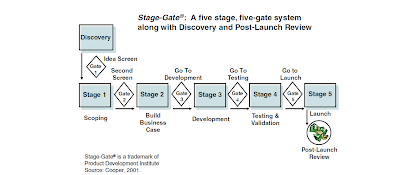
A Stage-Gate process is a conceptual and operational map for moving new product projects from idea to
launch and beyond—a blueprint for managing the new product development (NPD) process to improve
effectiveness and efficiency.
Stage-Gate, in its simplest format, consists of (1) a series of stages, where the project team undertakes the work, obtains the needed information, and does the subsequent data integration and analysis, followed by (2) gates, where go/kill decisions are made to continue to invest in the project.
Key things to remember in a Stage Gate Process:

Adaptability of Stage-Gate Process is really very important, and the aspect which makes it special is the customer feedback. It's the Agile or the Spiral approach to development where you seek customer feedback at various phases. The idea is: build-test-feedback-and-revise!!

In the end, ideas can come from anywhere, even outside the organization. So, a culture of open innovation is really important and Stage-Gate has been modified to include Open Innovation at its core.


A Stage-Gate process is a conceptual and operational map for moving new product projects from idea to
launch and beyond—a blueprint for managing the new product development (NPD) process to improve
effectiveness and efficiency.
Stage-Gate, in its simplest format, consists of (1) a series of stages, where the project team undertakes the work, obtains the needed information, and does the subsequent data integration and analysis, followed by (2) gates, where go/kill decisions are made to continue to invest in the project.
Key things to remember in a Stage Gate Process:
- Each stage is designed to gather information to reduce key project uncertainties and risks; the information requirements thus define the purpose of each of the stages in the process.
- Each stage costs more than the preceding one: The process is an incremental commitment one—a series of increasing bets, much like a game of Texas Hold’em. But with each stage and step increase in
project cost, the unknowns and uncertainties are driven down so that risk is effectively managed. - The activities within stages are undertaken in parallel and by a team of people from different functional
areas within the firm; that is, tasks within a stage are done concurrently. - Each stage is cross-functional, No department owns any one stage.
- Criteria against which the project is judged: These include must-meet criteria or knock-out questions
(a checklist) designed to weed out misfit projects quickly; and should-meet criteria that are scored
and added (a point count system), which are used to prioritize projects. - Outputs: a decision (Go/Kill/Hold/Recycle), along with an approved action plan for the next stage
(an agreed-to timeline and resources committed), and a list of deliverable and date for the next gate.

Adaptability of Stage-Gate Process is really very important, and the aspect which makes it special is the customer feedback. It's the Agile or the Spiral approach to development where you seek customer feedback at various phases. The idea is: build-test-feedback-and-revise!!

In the end, ideas can come from anywhere, even outside the organization. So, a culture of open innovation is really important and Stage-Gate has been modified to include Open Innovation at its core.




 Posts